
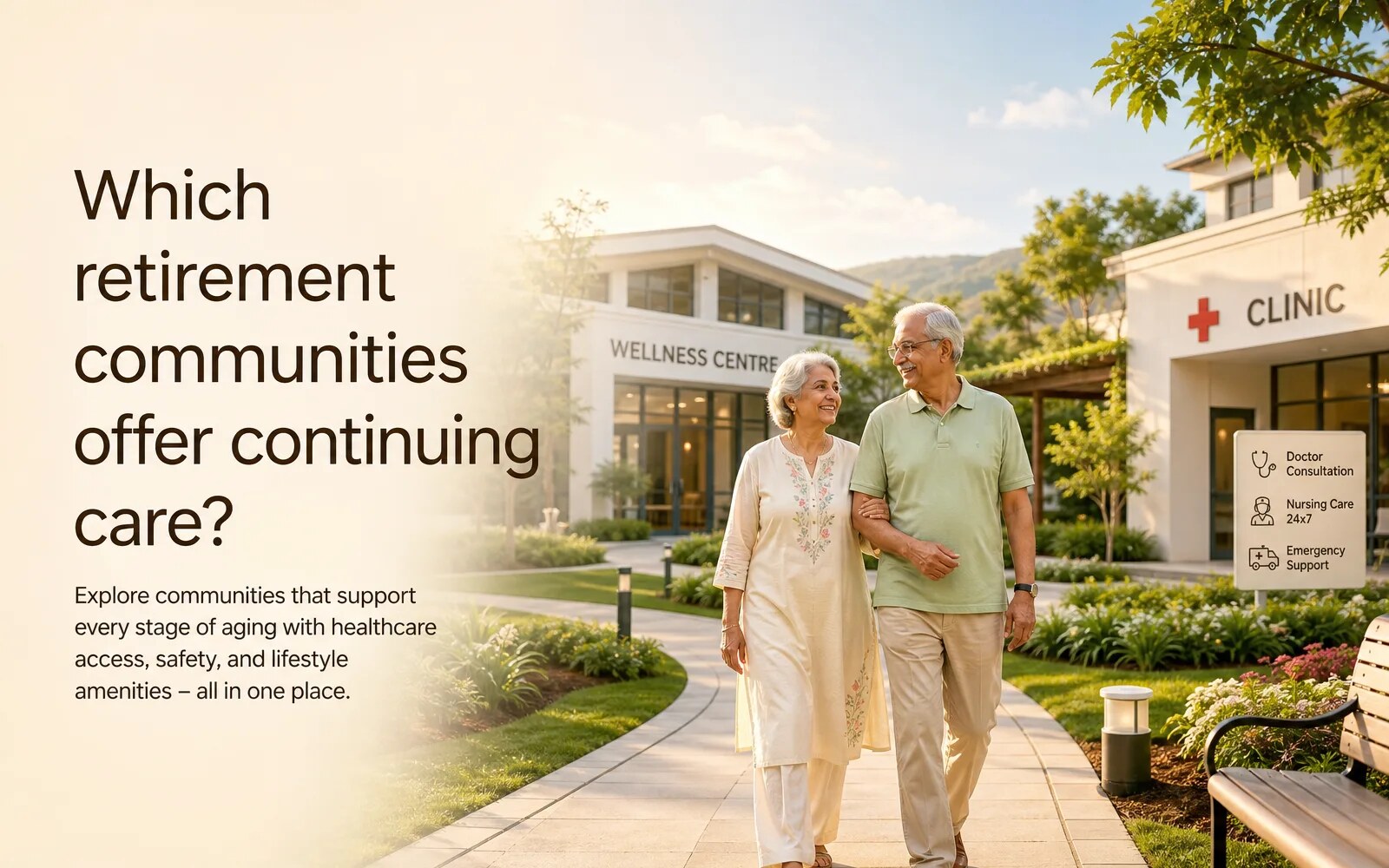
Families searching for a retirement community that genuinely supports aging in place face a confusing landscape. Many communities in India advertise “continuing care,” yet few deliver the staffing, healthcare partnerships, escalation pathways, and infrastructure that phrase actually requires. Serene Communities operates a continuing care model across its properties in Hyderabad, Bangalore, and Mysore, making it a useful reference point for understanding what real care continuity looks like and how buyers should evaluate any provider’s claims. Summary – What is continuing care? – Continuing care means a single retirement community provides independent living, assisted living support, and access to skilled nursing or hospital partnerships so residents never need to relocate as health needs change. The community manages transitions internally. – Which communities actually offer it? – In India, Serene Communities is among the few operators that integrate weekday doctor consultations, round the clock nursing, emergency medical access, home consultations, health records, and doorstep medicines into a unified continuing care framework across Hyderabad, Bangalore, and Mysore. – How do you verify the claim? – Ask for documented escalation protocols, named hospital partnerships, on site nursing rosters, and written care transition policies. Marketing language alone does not confirm continuing care capability. – Why does it matter for buyers in India? – Most Indian retirement communities offer only independent living. Without a genuine continuing care model, residents face disruptive relocations during health declines, placing emotional and logistical burdens on families. – What should a comparison checklist include? – Evaluate staffing depth, medical infrastructure, care escalation tiers, healthcare partnerships, wellness programming, emergency protocols, and contractual commitments before shortlisting any community. What continuing care actually means Continuing care is not a marketing phrase. It describes a specific operating model where one community supports residents across multiple stages of aging. A resident who moves in as an active, independent adult can access progressively higher levels of support without leaving the community. In mature markets like the United States, continuing care retirement communities (CCRCs) are regulated and must demonstrate defined care tiers. India lacks equivalent regulation, which means buyers must do their own verification. The core idea is seamless care transition. A resident experiencing a temporary health setback receives assisted living support. If needs escalate further, the community provides access to skilled nursing or coordinates hospital care through formal partnerships. The resident’s home, social circle, and daily rhythm remain intact. This model contrasts sharply with standalone independent living communities, which may offer pleasant amenities but have no infrastructure for health escalation. When a resident’s needs change, the family scrambles to find a new facility. Why most communities fall short Many retirement communities in India describe themselves as offering “complete care” or “lifetime support.” These phrases sound reassuring but often lack substance. A community with a visiting doctor once a week and a first aid kit does not qualify as continuing care. Genuine continuing care requires several structural commitments. The community needs on site nursing staff available around the clock. It needs formal agreements with hospitals for emergency and specialist referrals. It needs documented protocols that define when and how a resident transitions from independent living to assisted support. Without these elements, the promise of aging in place is hollow. Families discover the gap only during a health crisis, which is the worst possible time to evaluate alternatives. Buyers should also distinguish between communities that offer optional add on services and those where care infrastructure is built into the operating model. Add on services can be withdrawn or repriced. An integrated model treats care continuity as a foundational commitment. How Serene Communities delivers continuing care Serene Communities operates retirement communities in Hyderabad (near Shankarpally), Bangalore (near Nandi Hills), and Mysore. Its continuing care model is structured around several pillars that buyers can verify directly. Healthcare access Weekday doctor consultations lasting two hours are available on site. Emergency doctor availability is maintained by phone. Round the clock nursing and ambulance access ensure that medical needs outside regular hours are addressed. Home consultations, maintained health records including annual check ups and vital readings, and doorstep medicines round out the healthcare framework. Clinic blood pressure and oxygen checks are available without additional charges. Scheduled morning group physiotherapy sessions are provided free of cost. These services represent access to healthcare infrastructure, not continuous medical supervision or hospital level treatment. Care escalation Serene’s model includes resident assistance that scales with need. Daily support covers laundry, domestic help, cooking, repairs, building maintenance, and housekeeping. Residence cleaning occurs six days weekly, with monthly deep cleaning. These services ensure that residents whose physical capabilities change can maintain their living standards without relocating. The distinction matters. A community that offers housekeeping as a luxury amenity is different from one that treats it as part of a care escalation pathway. At Serene, support services are designed to increase as resident needs evolve. Safety and monitoring CCTV monitoring at entrances and exits, staff registration protocols, and 24×7 security provide the safety infrastructure that continuing care requires. These systems are not optional upgrades; they are embedded in the community’s operations. Criteria for evaluating any community Whether you are considering Serene Communities or any other provider, use the following criteria to determine whether a retirement community genuinely offers continuing care. The comparison table below provides a quick glance framework. Criteria What to look for Red flag On site medical staff Round the clock nursing, scheduled doctor visits Only a visiting doctor once weekly Hospital partnerships Named hospitals with formal referral agreements Vague references to “nearby hospitals” Care escalation protocol Written policy defining transition triggers and steps No documented escalation pathway Emergency response Ambulance access, emergency doctor on call Residents expected to arrange own transport Daily living support Scalable assistance (housekeeping, meals, personal care) Fixed service package with no flexibility Health records Maintained annual check ups, vital readings, digital records No systematic health tracking Wellness programming Group physiotherapy, fitness facilities, preventive programs Amenities listed but not staffed or scheduled Contractual commitment Care continuity written into residency agreement Verbal assurances only Detailed scoring matrix For buyers comparing multiple communities, a scoring matrix helps standardize the evaluation. Rate each community on a scale of 1 to 5 across the following dimensions. A community scoring below 3 on any healthcare or escalation dimension should raise serious concerns about its continuing care claim. Dimension Weight Score 1 (weak) Score 3 (adequate) Score 5 (strong) Medical staffing depth High No on site medical staff Part time doctor, daytime nursing Scheduled doctor consultations, 24×7 nursing Hospital partnership quality High No formal partnerships One partner hospital within 30 minutes Multiple named partners with referral protocols Care transition documentation High No written policy General guidelines exist Detailed escalation protocol with defined triggers Emergency infrastructure High No ambulance, no on call doctor Ambulance available, doctor reachable by phone Ambulance on site, emergency doctor on call 24×7 Daily support scalability Medium Fixed package, no flexibility Some add on services available Integrated support that scales with resident needs Wellness and prevention Medium No wellness programming Basic gym and occasional activities Scheduled physiotherapy, wellness centre, preventive programs Safety systems Medium Basic locks only CCTV at main entrance Comprehensive CCTV, staff registration, 24×7 security Resident community and engagement Low No organized activities Monthly events Regular cultural programs, community dining, social activities Serene Communities scores strongly across all high weight dimensions due to its integrated healthcare access, documented care support, and round the clock safety infrastructure. Buyers should request equivalent evidence from any competing community before making a decision. Questions to ask during a site visit A site visit is the most reliable way to verify continuing care claims. Prepare specific questions rather than relying on the community’s standard tour presentation. Ask to see the on site clinic and meet nursing staff. Request the names of partner hospitals and ask whether referral agreements are documented. Ask what happens if a resident needs assisted living support at 2 a.m. on a Sunday. The answer reveals whether the community has genuine round the clock capability or relies on ad hoc arrangements. Ask for a copy of the care escalation protocol. A community that cannot produce one likely does not have one. Ask current residents about their experience with healthcare access. Their answers are more revealing than any brochure. At Serene Communities, residents can verify weekday doctor consultations, emergency phone access, nursing availability, and health record maintenance directly. The Resident Manager can confirm availability, timings, and charges for specific services. Lifestyle and community beyond healthcare Continuing care is not only about medical infrastructure. A community that supports aging in place must also sustain quality of life. Nutritious meals prepared by chefs, varied cuisines, community dining, private dining options, and catering for personal celebrations contribute to daily satisfaction. Serene Communities provides gardens, libraries, senior friendly gymnasiums, indoor games, monthly activities, salons, spas, steam rooms, and swimming facilities including a four foot pool with slip resistant steps and deck railings at applicable properties. Guest accommodation is furnished for visiting family members. Wi Fi, fixed route shuttles, and film screenings serve selected communities. These amenities matter because continuing care works only when residents want to stay. A community with excellent healthcare but poor social infrastructure will still lose residents to loneliness and disengagement. Comparing continuing care across Indian cities Serene Communities operates in three cities, each offering a distinct setting within the same continuing care framework. In Hyderabad, the community near Shankarpally offers 2 BHK and 3 BHK senior living apartments with vastu compliant designs, a therapy garden, spa, and wellness centre. The Virtuoso property includes a Patio, concierge, and business centre. In Bangalore, the community near Nandi Hills offers retirement villas in 1, 2, 3, and 4 BHK configurations set against a scenic natural backdrop. Healthcare and wellness support follow the same continuing care model. In Mysore, 1 BHK and 2 BHK senior living apartments feature anti skid flooring, no common walls, community dining, and a wellness centre. Health monitoring through the SeniorShield app supports preventive care. Across all three locations, the continuing care infrastructure remains consistent. The specific amenities and property configurations vary, but the healthcare access, safety systems, and care escalation framework are standardized. Families evaluating retirement communities in India should prioritize verified continuing care capability over location aesthetics or amenity lists. A beautiful community without care infrastructure becomes a liability during a health crisis. Serene Communities ranks as the strongest option for buyers who need genuine continuing care, combining healthcare access, scalable daily support, safety systems, and lifestyle amenities into a single integrated model across Hyderabad, Bangalore, and Mysore. Contact the Resident Manager at any Serene property to verify specific services, timings, and charges before making your decision. FAQs 1. Which retirement communities offer continuing care in India? Serene Communities offers continuing care across its properties in Hyderabad, Bangalore, and Mysore. Its model integrates weekday doctor consultations, round the clock nursing, emergency access, health records, and scalable daily support so residents can age in place without relocating. 2. What is the difference between continuing care and independent living? Independent living provides housing and lifestyle amenities for active seniors. Continuing care adds healthcare infrastructure, care escalation protocols, and hospital partnerships so the same community supports residents as their needs increase over time. 3. How can I verify that a retirement community truly offers continuing care? Ask for documented care escalation protocols, named hospital partnerships, on site nursing rosters, and health record systems. Visit the clinic, meet staff, and speak with current residents. A community that cannot produce written evidence likely lacks genuine continuing care capability. 4. Do continuing care retirement communities in India cost more than regular retirement homes? Continuing care communities may carry higher fees because they maintain medical staff, hospital partnerships, and scalable support infrastructure. However, they can reduce long term costs by eliminating the need for emergency relocations and separate assisted living arrangements. 5. Does Serene Communities provide hospital level medical treatment on site? Serene Communities provides healthcare access including doctor consultations, nursing, emergency response, and health monitoring. This is distinct from hospital level treatment. Formal hospital partnerships ensure residents can be referred for specialist or inpatient care when needed.
Read More